


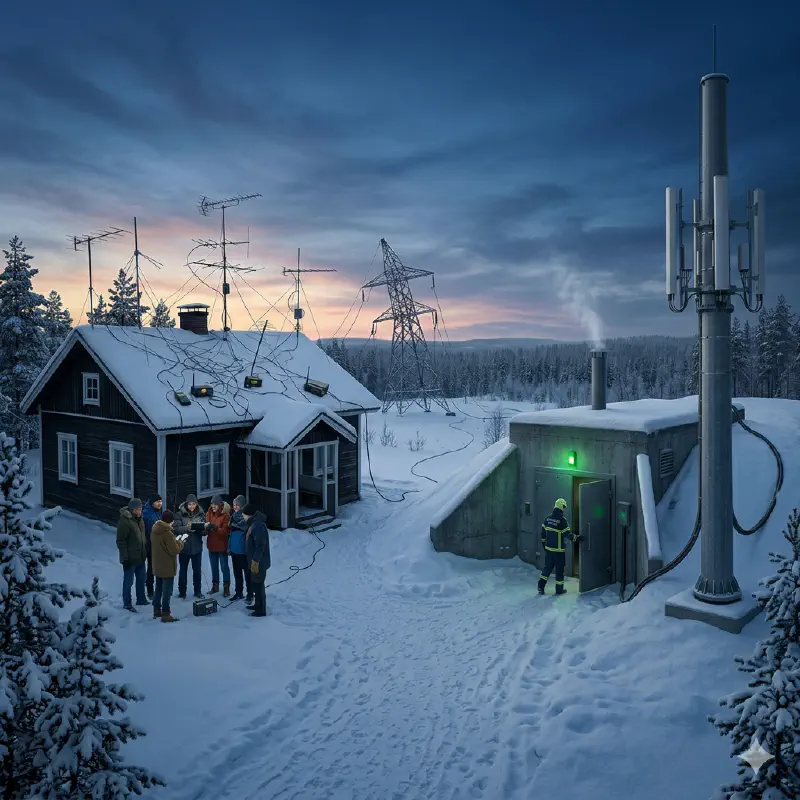
Community radio — a hobby wearing body armor
A critical look at community radio's crisis preparedness claims — and the psychological risks of feeling safer than you are.
Over the past five years, a volunteer-driven crisis communication concept called “community radio” has gained traction in Finland. The idea is simple: build a decentralized radio network that keeps communities connected when everything else fails. It’s a compelling pitch. It’s also built on a set of assumptions that don’t survive contact with reality.
What the project claims
Community radio positions itself as a resilient alternative to commercial communications during crises — specifically when mobile networks fail due to power outages, or when individuals can’t reach authorities. The network combines mid-range FM transceivers (RHA68 band, ~25 W) with short-range license-free PMR446 handsets to form a village-level relay topology, with claimed ranges of up to 120 kilometers between nodes.
Where it runs into trouble
The power outage premise is shaky. Finnish telecom regulations mandate backup power for communications infrastructure based on a priority tier system — ranging from weeks of autonomous operation at the top tiers down to three hours at the lowest. Even mobile base stations have mandated minimums while community radio nodes have none.
VIRVE doesn’t fail when the grid does. The official TETRA network is backed by stationary generators and battery systems at key sites. A two-hour power outage has zero operational impact on VIRVE by design.
PMR446 range is measured in hundreds of meters, not kilometers. The last-hop device in the proposed topology caps at 0.5 W and a practical range of roughly three kilometers in ideal conditions. Most rural users the system targets would be outside that radius.
The network is uncoordinated by design. No frequency management, no priority mechanism for actual emergencies, no audited uptime, no trained operators. It can be jammed with off-the-shelf hardware.
It’s explicitly disconnected from authorities. Finnish authorities have decided community radio is not integrated into any official network. Information flows one way, always behind official broadcast channels.
The less obvious problem
Beyond the technical gaps, community radio creates a specific psychological risk: it functions as security theater. Participating in a training day and helping install an antenna produces a genuine sense of preparedness. The problem is that this sense may not correspond to actual capability — and it actively competes with behaviors that do work, like keeping a battery-powered FM radio ready and understanding how 112 operates without a SIM card.
Research on disaster preparedness shows that perceived safety reduces investment in understanding how real systems work. Community radio doesn’t just fail to solve the problem. In some cases, it displaces the solution.
What the full research covers
We’re waiting on regulatory documentation from Traficom before publishing the complete analysis. The full piece covers the specific legal framework governing Finnish communications infrastructure, a detailed breakdown of the RHA68 and PMR446 topology limitations, the psychological mechanisms behind risk compensation and security theater in preparedness contexts, and a realistic assessment of where community radio does have legitimate value — because it does have some.
This article is a preview of an upcoming research piece on Finnish crisis communications preparedness.
Back to all blogs