


Lighting, sound, and broadcast for a 300-year-old church's anniversary
Full technical production for Paltaniemen kuvakirkko's tricentennial in Kajaani: a 36-fixture lighting rig for protected 18th-century frescoes, live sound for a cantata and a ceremony, and an OB1 broadcast to Radio Dei.
“Don’t drill into a 300-year-old fresco.”
That instruction, or something close to it, tends to reorganize how you think about a lighting plan. Most event technical production starts with a rigging grid, a truss plan, and a list of hard points to hang from. Paltaniemen kuvakirkko gave us none of those, and for good reason.
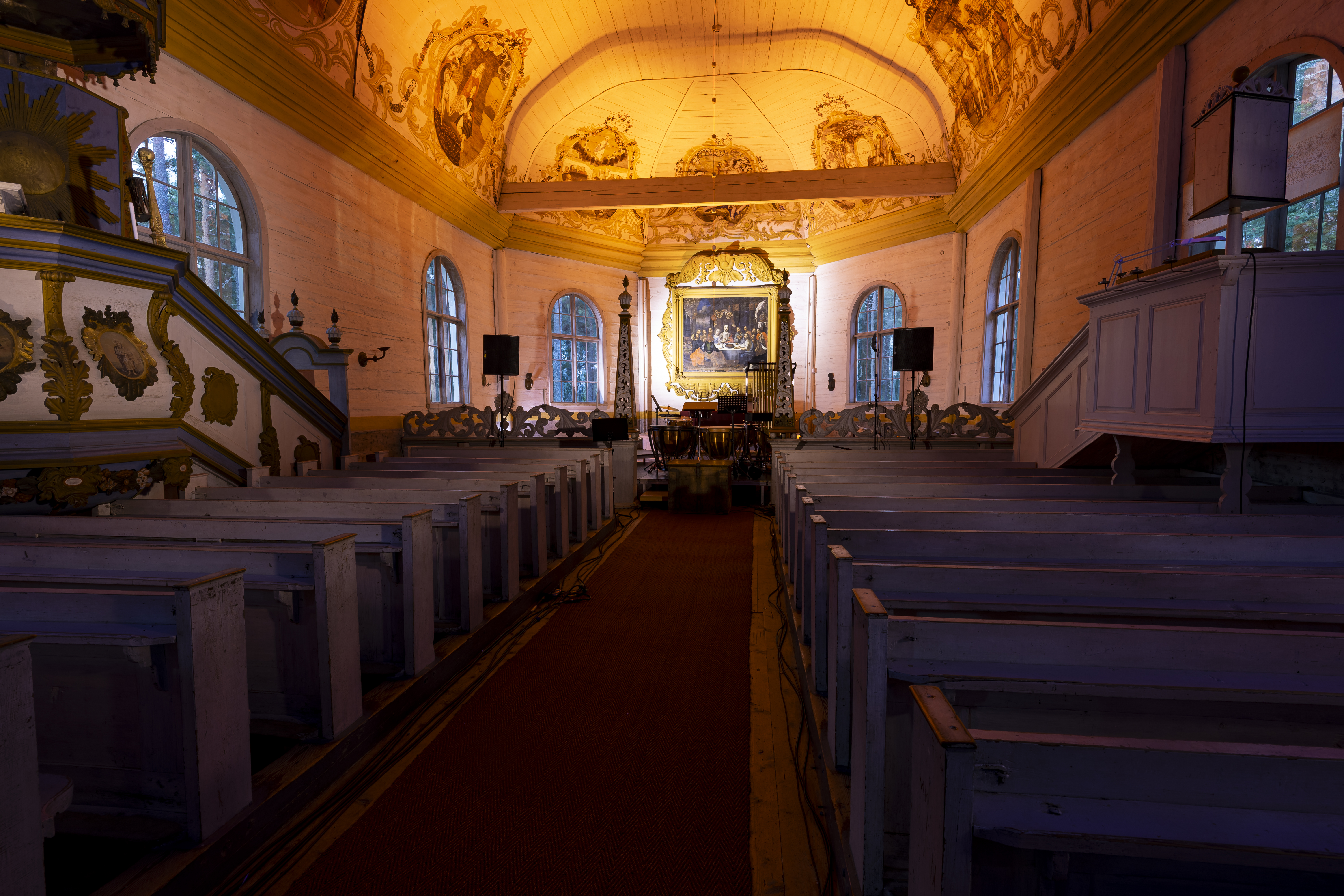
Paltaniemen kuvakirkko’s tricentennial
Background
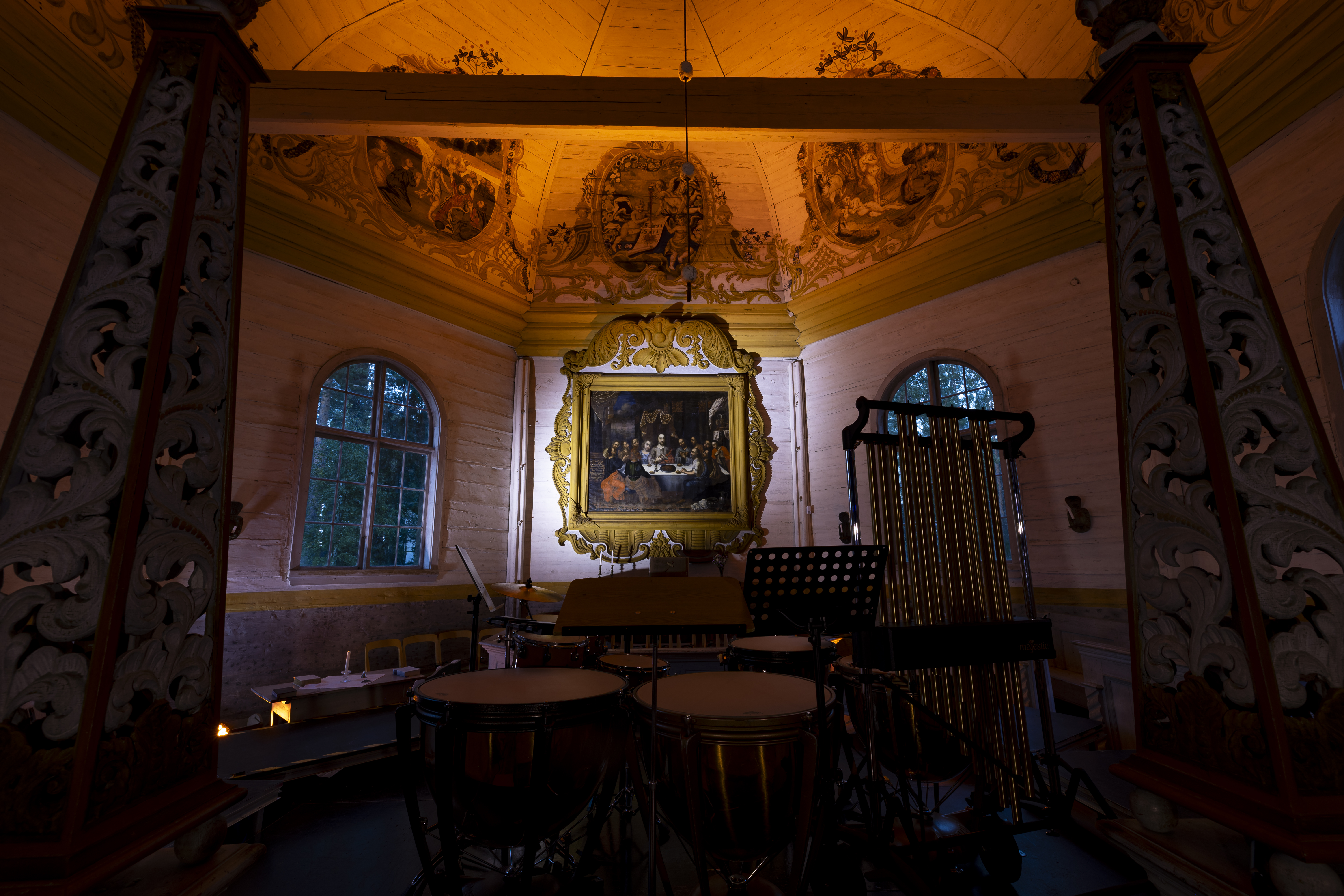
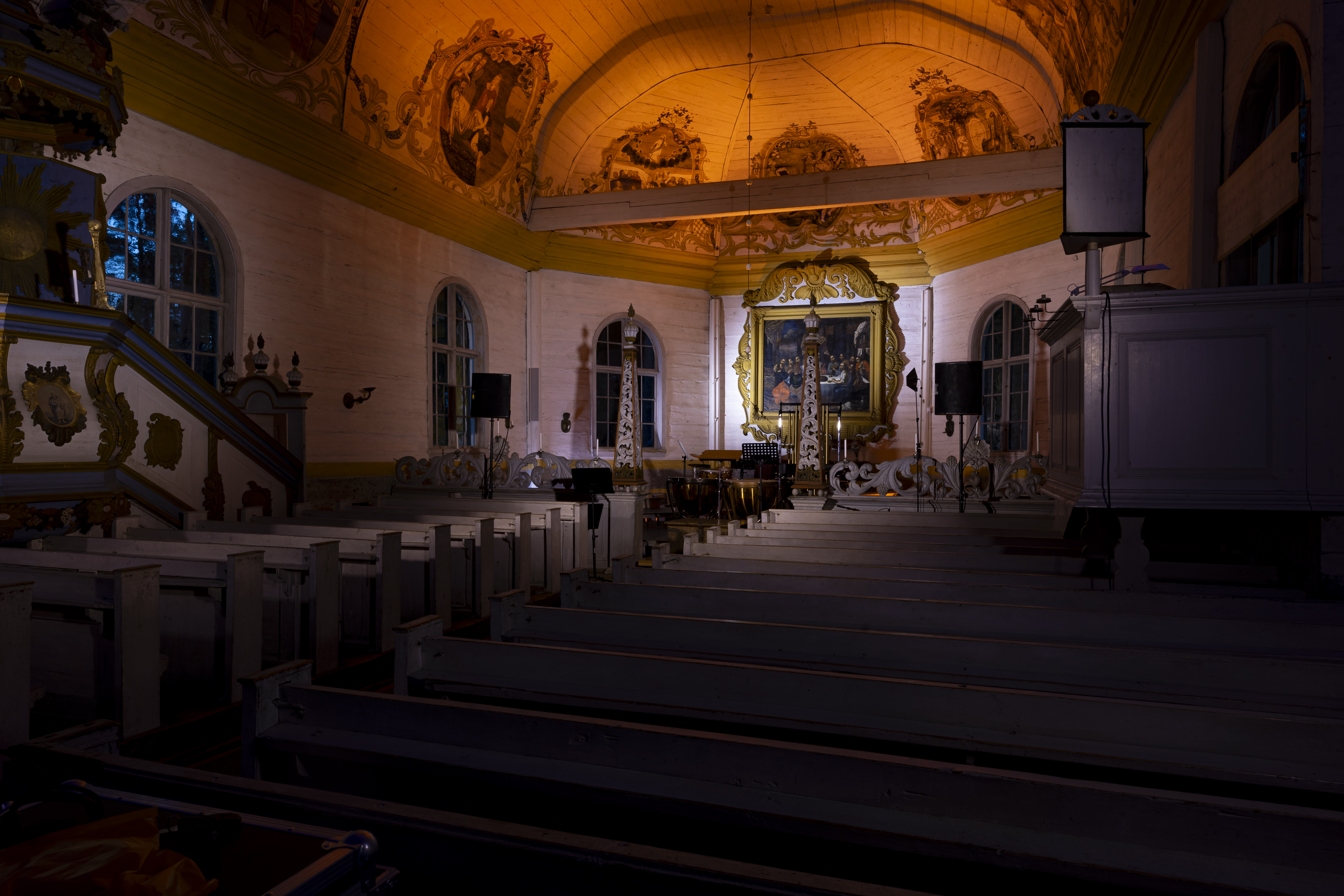
Paltaniemen kuvakirkko, the “picture church” of Paltaniemi near Kajaani, is one of Finland’s most significant historic interiors — a wooden church with its ceiling and walls almost entirely covered in paintings by Emanuel Granit. The church marked its 300th anniversary over the weekend of 15–16 August 2026: on Saturday evening, a performance of Einojuhani Rautavaara’s Kainuu-kantaatti, and on Sunday morning, a festival service led jointly by Bishop Jari Jolkkonen of the Kuopio diocese and Paltamo’s own vicar, Esa Oikarinen. The Sunday service was broadcast live to Radio Dei.
The cantata carries its own piece of the building’s history. Rautavaara composed it in 1976 as a commission for the church’s 250th anniversary, and its premiere drew a crowd too large for the church to hold — by Kainuun Sanomat’s account, thousands showed up and many had to stay outside. The piece was then rarely performed again for fifty years, until Kajaani parish’s Cantate-kuoro and the Kaukametsä chamber choir rehearsed a roughly 25-voice project choir to bring it back to Paltaniemi for the 300th.
This wasn’t a broadcast job with lighting attached, or a lighting job with a stream attached. It was full technical production for a two-day event in a building that couldn’t be treated like a normal venue: 36 fixtures illuminating the paintings, live sound for both a cantata and a spoken ceremony, and a broadcast feed going out over OB1.
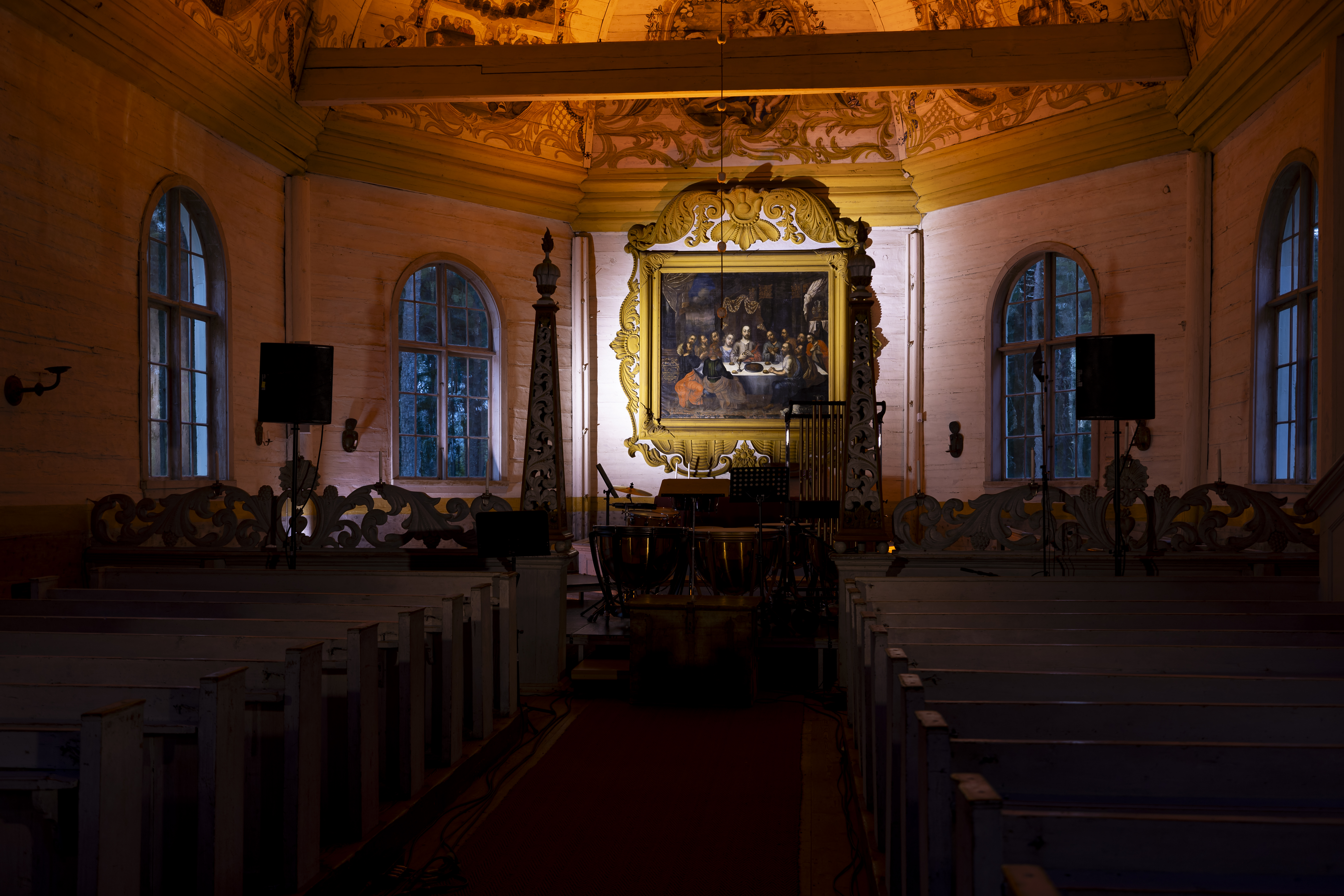
Lighting: 36 fixtures, zero rigging points
A protected 18th-century building doesn’t have a grid, a lighting bar, or spare electrical capacity to spare — and Paltaniemen kuvakirkko has none of the three. The fixtures illuminating the ceiling and wall paintings couldn’t be hung from the structure itself, and the building’s wiring wasn’t built with a 36-fixture rig in mind.
The solution was ground-supported and floor-based positioning throughout: stands and low-profile mounts placed to wash the paintings from angles that wouldn’t cast the congregation’s own shadows across the frescoes, with every fixture’s throw and beam angle worked out on-site rather than from a plan. Power was the other half of the problem. Instead of pulling everything from one circuit and finding out mid-event that it couldn’t take the load, the rig was split and balanced across the building’s available circuits, with the whole plot run from a single DMX control point so the look could be adjusted for the cantata on Saturday and toned down for the more contemplative ceremony on Sunday without re-cabling anything.
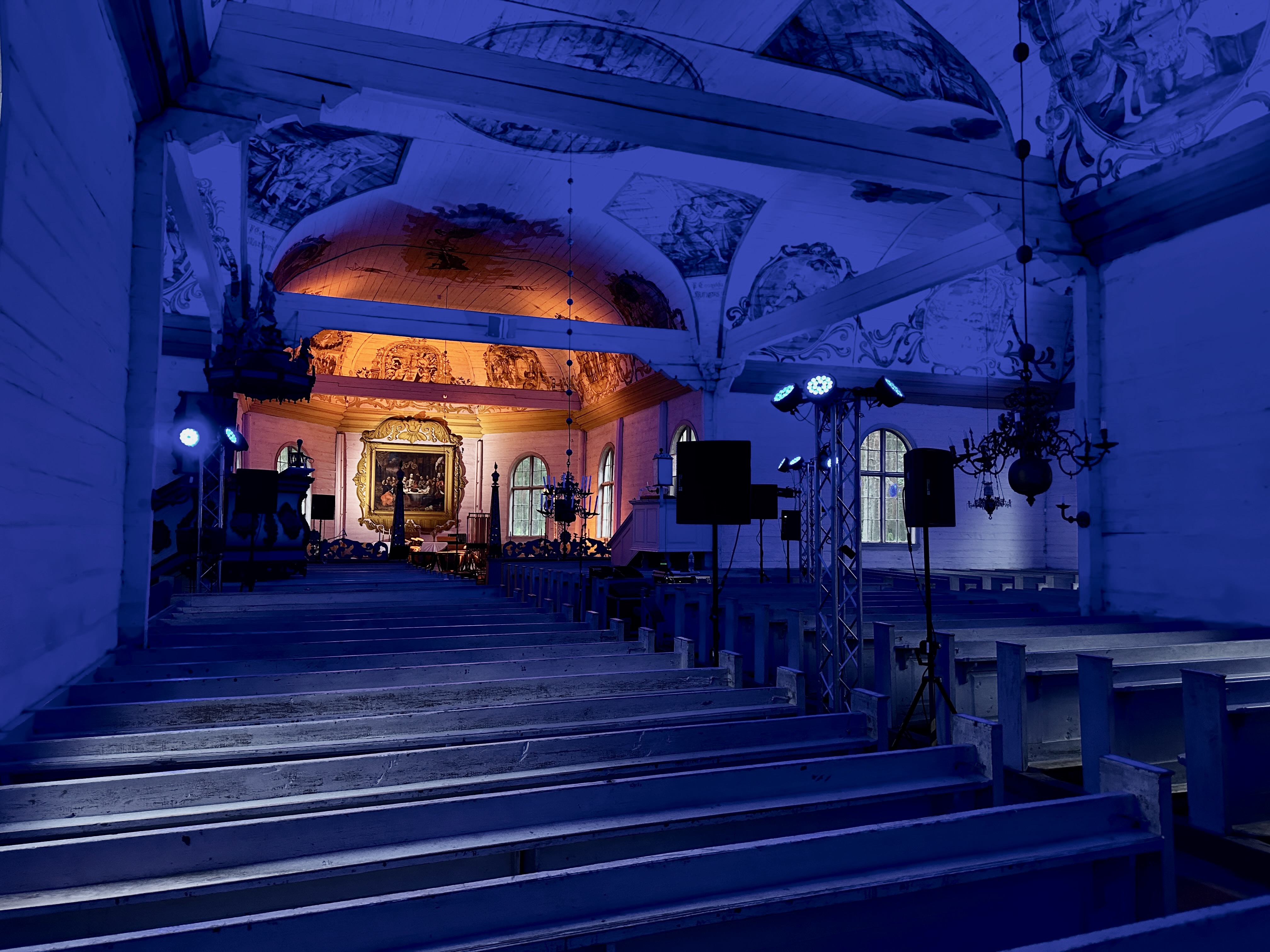
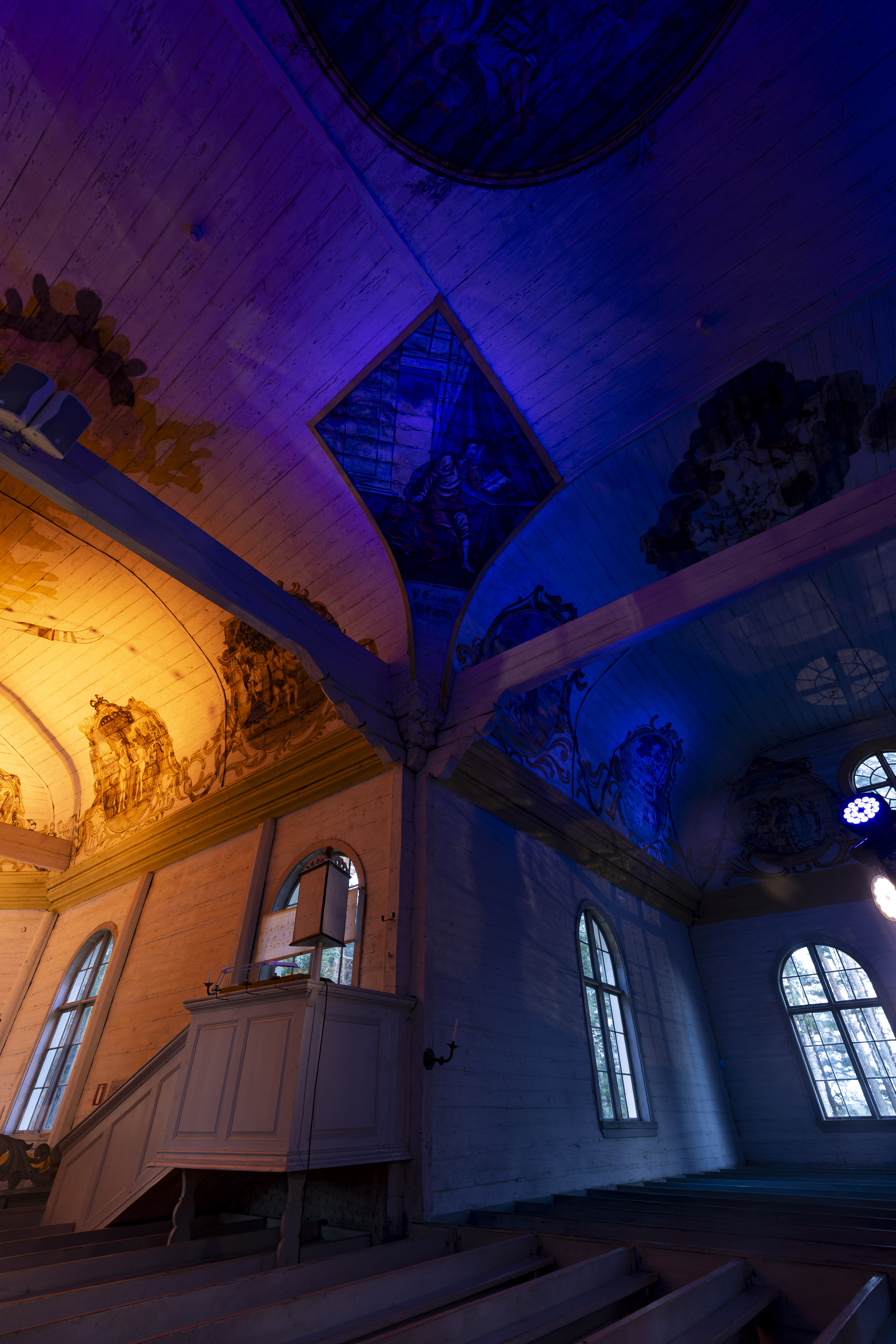
The result was a church interior that read clearly on camera and to the room, without a single new hole in three centuries of paintwork.
Sound and broadcast: a cantata and a ceremony are not the same show
Saturday and Sunday asked for almost opposite audio treatment. The church has no organ, only a foot-pumped harmonium, so the cantata’s instrumental color comes entirely from percussion — timpani, snare, vibraphone, tubular bells — alongside a roughly 25-voice choir, a narrator, and vocal soloists. Balancing that through front-of-house is a different job than Sunday’s ceremony, which was built around spoken word and hymns with a bishop and a vicar presiding, where intelligibility mattered more than headroom. Running both from the same rig meant the FOH setup had to be re-balanced between the two, not just re-used.
For the Sunday broadcast to Radio Dei, we used AirCore OB1. The same SRT-based signal path OB1 uses for remote broadcasts elsewhere applied here: a stable feed out of a building with unremarkable connectivity, without a satellite truck or a multi-person broadcast crew standing in the aisle. OB1 took the ceremony’s mix and got it to Radio Dei cleanly, while the technical footprint inside the church stayed small enough not to compete with the event itself.
Bottom line
Paltaniemen kuvakirkko’s anniversary weekend needed a lighting designer, a live sound engineer, and a broadcast engineer to act as one team, in a building that vetoed the easy version of all three jobs. The paintings stayed untouched, the cantata and the ceremony each got the mix they needed, and the feed reached Radio Dei without incident. That’s the actual scope of what “technical production” means for us: not just getting a broadcast signal out of a difficult location, but the lighting, the sound, and the broadcast working together as one plan.
How Fremen can help with your event
If you’re producing an event in a space that doesn’t fit a normal technical rider — a historic building, a location with no rigging or power infrastructure, a broadcast that has to share the room with the audience — tell us what you’re working with. We’ll tell you what’s possible.
See how we approach full-scope production in demanding venues, or talk to us about your event directly.